LLMday

Large Language Models, Agents & AI Systems

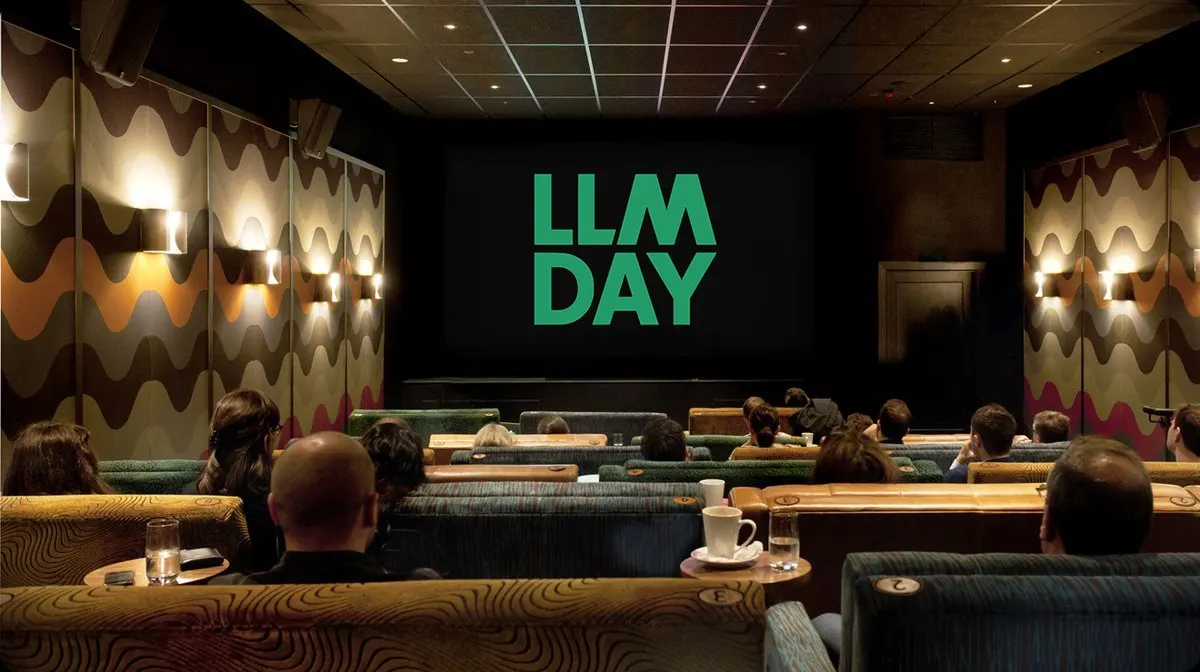
May 28, 2026 Everyman Canary Wharf, London, UK

1
Day
30+
Speakers
3
Tracks
150+
Attendees

LLMday is a worldwide series of community events for engineers building with large language models, AI agents and machine learning. Across cities around the world, we bring together practitioners working on AI-powered products and systems to share real-world experience, learn from each other and explore how software engineering is changing in the age of AI.

Companies presenting:

Altinity, AWS, Bead AI, Bolt EU, Chattermill, ClearBank, Doubleword, Future Processing, Google, Great Wave AI, Haus of EL, IBM, Ignite, Illuminate, Infonetica, Northslope Technologies, Nuvolaris, OctaTech, Pegasystems, Provio, Redis, SeRP, Skipton Building Society, Social Discovery Group, The Mental Health Foundation, TheAiExpert.ai, Typeform, Wayve, Witan Labs, WTW

Topics so far:

This is a past event, what's next?

Schedule

May 28, 2026 • 3 parallel tracks • 9AM - 5PM • London, in-person
View
Track 1 • screen 1

09:30

Judith Schunke

KeynoteFrom Code to Conviction: Using Neuroscience to Deliver Technical Talks That Influence

Ignite & Illuminate
In technical environments, deep expertise is often assumed to speak for itself, yet exceptional insight does not always translate into audience impact. As a result, valuable ideas fail to resonate, and opportunities to influence decisions are missed. This session addresses the gap between subject matter expertise and compelling delivery, particularly in high-stakes moments such as conference keynotes, executive briefings, and critical project updates. Leveraging the latest neuroscience, you will learn how to structure complex ideas with clarity and communicate them effectively, use your voice and presence to connect, and prepare in a way that ensures your message holds under pressure. Designed for engineers, developers, and technical leaders, this session will help you turn deep expertise into talks that build credibility, engage your audience, and drive action.... Read more

10:00

Coffee break

Main lobby

10:30

Eiriel De Roxas & Lorenzo Bellucci

Two designers walk into an AI conference...

Haus of EL
Most talks at an AI conference focus on building with AI. This one is about surviving with it, then thriving. As co-founders of Haus of EL, we will share how AI has changed things for us and other small businesses, empowering them to build and create without worrying about operational overheads and what this revealed about design as a practice.... Read more

11:00

Kate Tertiienko

When Engineers Stop Thinking: How to Make AI Serve Us, Not Replace Us

Infonetica
AI-assisted development is quickly becoming an expectation rather than a choice. Under constant pressure to deliver faster, engineers increasingly delegate not just implementation, but exploration, learning, and design thinking to AI tools. While this can create short-term productivity gains, it also introduces quieter risks: declining system understanding, reduced curiosity, and an explosion of AI-generated code and documentation that shifts cognitive load onto reviewers and senior engineers. Drawing on two decades of experience building and scaling systems across multiple countries, startups, and regulated domains, the speaker examines how this dynamic affects engineers at different stages of their careers. Experienced engineers may still recognise when to question or override AI-generated solutions, but those entering the industry risk shipping systems they have never fully reasoned about. Rather than arguing for restricting AI usage, this talk focuses on the harder problem: how to build an engineering culture where judgment, ownership, and understanding remain first-class expectations, even when AI is everywhere. Attendees will leave with practical cultural and leadership patterns for ensuring AI amplifies engineering capability instead of eroding it.... Read more

11:30

Adefisayo Adejumo

I Locked My Laptop. My Agent Never Did

Full Stack Engineer
Early in my backend career, I worked alone on systems handling real money and real users. I locked my laptop before leaving my desk, not because a policy required it, but because an unattended terminal with database access is an unguarded door. Then we started deploying LLM agents, and nobody locked anything. Today, many agents operate as permanent unattended sessions with production credentials. They call APIs, read data, and execute actions inside real systems without scoped identity, attribution, or runtime approval. In practice, an LLM agent connected to tools is an unattended session with system access. The engineers wiring agents to production systems are making security decisions by default. This talk makes those decisions deliberate. It introduces the LAR framework: Lock, Attribute, Require — three practical backend patterns for governing LLM agents at runtime. Lock. Agents should not hold standing credentials. Instead, systems generate dynamic, task-scoped credentials that exist only for the duration of an agent session. This reduces the blast radius of a compromised agent and applies the same principle engineers follow when locking their terminals. Attribute. Every agent action must be traceable. Using OAuth identity federation and delegated scopes, tool calls carry identity context so that logs clearly show which user initiated the request, which agent executed it, and what permissions were granted at that moment. Require. Certain actions should never be executed automatically. Destructive changes, financial transactions, or sensitive operations should pause until a human explicitly authorises them. Using approval flows such as Client-Initiated Backchannel Authentication, agents can request permission before completing irreversible tasks. The talk includes a live Python demonstration comparing two versions of the same LLM-powered backend agent. The first runs with permanent credentials, broad access, and no attribution. The second operates under the LAR framework with session-scoped credentials, identity propagation through tool calls, and human approval for sensitive operations. Attendees see the difference between an ungoverned agent and a governed one interacting with the same production-like environment. Key takeaways for attendees: - A clear mental model for governing LLM agents using the LAR framework: Lock, Attribute, Require - Practical patterns for implementing session-scoped credentials for agents in Python to avoid long-lived access tokens - How to use OAuth identity federation to attribute agent tool calls to the initiating user and agent identity - How to introduce human-in-the-loop approval for high-risk agent actions before execution - A practical understanding of the architectural difference between an ungoverned agent and a governed production agent A practical understanding of the architectural difference between an ungoverned agent and a governed production agent I locked my laptop. It is time we built systems that do the same.... Read more

12:00

Claudia De Jeu Boronat

AI Is Changing How We Think: Are We Ready for What Comes Next?

WTW
We are living through a once-in-a-generation shift, not just in technology, but in how humans think. For the first time, we are raising a generation that will never need to learn, decide, or create without AI. At the same time, professionals across industries are rapidly adopting AI tools that are transforming how work gets done; automating tasks, accelerating decisions, and reshaping what it means to be valuable. But beneath the surface, a deeper transformation is happening. This keynote explores how AI is changing: the way we think and learn how we make decisions what skills truly matter and how we define our own value in the workplace Blending real-world examples from daily life and industry with the latest research and trends, this talk challenges the audience to reflect on an uncomfortable question: Are we becoming more intelligent, or simply more dependent?... Read more

12:30

Lunch & networking

Main lobby

13:30

Emily Phuong Nghiem

Teaching RAG to read: making charts, tables and equations reliable on individual learners' budget

Provio
Standard RAG fails silently on the content that matters most in textbooks and financial documents, a chart becomes an empty image tag, a table of financial ratios disappears, an equation becomes garbled text. This talk covers our lessons learned making a learning product reliable on multimodal content, using Chinese open-source vision models that cost a fraction of proprietary alternatives.... Read more

14:00

Russell Miles

Does AI Deliver Waterfall? An exploration of the metaphors we still live by and how they are changing with AI

ClearBank
The waterfall debate isn’t dead. It just changed shape. When AI entered software engineering, it brought with it the oldest metaphor in the industry: the factory. Developers prompt. AI produces. Code ships. Faster, cheaper, more. The conveyor belt is back, and this time it’s powered by something that sounds like it understands you. But the factory metaphor was wrong in 1970, and it is wrong now. Software engineering was never manufacturing. It was never an assembly line. Peter Naur told us in 1985 that programming is theory building. A fundamentally cognitive, creative, collaborative act. The code was never the whole value. The understanding was. This keynote takes a deliberately contentious proposition and uses it to crack open the metaphors that still govern how teams think about software, collaboration, and intelligence. Drawing from the AI Literacy for Software Engineers framework, cognitive science, philosophy of mind, and 500 years of technology panics, you’ll take away practical tools to see your own metaphors, challenge them, and begin designing collaboration spaces where human and artificial intelligence actually thrive together. You will leave with a new way to see your relationship with AI tools. Not as a faster you. Not as a threat. As a fundamentally different kind of intelligence that requires a fundamentally different kind of collaboration space: From factory-thinking to habitat thinking.... Read more

14:30

Harrison Kirby

Operating LLMs Where Failure Isn’t an Option

Great Wave AI
Large Language Models are inherently probabilistic systems, yet many of the environments adopting them demand determinism, auditability, and accountability. In these contexts, “mostly correct” is indistinguishable from failure, and reliability cannot be achieved through prompt tuning or model alignment alone. This talk argues that determinism is not a model property but an architectural one: control must be engineered through orchestration, validation layers, policy enforcement, and structured human oversight. It further explores how scaling reliable AI systems is less about adding workflow branches and more about standardizing governed agent primitives, shared contracts, constraints, and evaluation frameworks that allow flexibility within certified boundaries.... Read more

15:00

Networking & Sponsor Crawl

Main lobby

15:30

Erik Schwartz

From Context To Impact: How To Ship An AI App In A Day

TheAiExpert.ai
This year I argued that context engineering is the real power tool behind great prompts. Next year I want to show what happens when you take that seriously and push it all the way to shipping real software in a single day. In this session we will move from theory to practice. I will unpack the context patterns that actually hold up once you leave the playground and build for real users. Multi layer memory, data boundaries, llms.txt style controls, retrieval patterns that survive messy SharePoint and inboxes, and the review loops you need so legal, compliance and IT can sleep at night. Then I will connect it to something very practical. My “Ship Your First App In A Day” workshops, where non technical leaders go from “what is a terminal” to a deployed, context aware AI app by 5pm. I will break down the scaffolding that makes that possible. How we design prompts around specific jobs to be done, how we shape context so models stay on track, and how we hand these experiments over to professional engineering teams without losing the magic. You will leave with a concrete blueprint to take your own prompt engineering practice from clever instructions on a screen to working AI apps that your business can actually use.... Read more

16:00

Dr David Crepaz-Keay

Building a Safe and Effective Mental Health Support Bot: The Mental Health Foundation Approach

The Mental Health Foundation
As generative AI is increasingly applied to mental health, the risks of harm, misinformation, and inappropriate support grow alongside its potential benefits. This presentation describes the Mental Health Foundation’s approach to building a mental health support bot that is safe, ethical, and effective—placing mental health expertise at the centre of prompt engineering. The work builds on the speaker’s experience developing the original Public Health England Mind Plan tool, now hosted by NHS England, and applies established public mental health principles to large language model design. The talk explores how prompt engineering can be used to define clear role boundaries, prevent diagnostic or therapeutic overreach, respond appropriately to distress, and ensure consistent signposting to human support. Rather than optimising for fluency alone, the Mental Health Foundation’s approach uses prompt constraints, tone guidance, and escalation logic to prioritise safety, trust, and real-world use in sensitive contexts. The session also reflects on collaboration between mental health specialists and technical teams, demonstrating how domain-led prompt design reduces risk while enabling genuinely supportive interactions. This presentation offers a practical case study in building mental health bots that are helpful without being unsafe—and shows why mental health applications require more than generic AI capability.... Read more

16:30

Andrei Shcherbinin

Hybrid Rule+MLLLM Moderation at Scale

Social Discovery Group
Case study on scaling hybrid moderation pipelines, blending rules, MLLLM classifiers for gray-area chats, and routing to reviewer queues. Andrei will provide end-to-end workflows with policy-aligned labeling, imbalance-aware evaluation beyond accuracy, precise thresholding, and moderator feedback loops to detect drift and adapt to shifting abuse tactics in production.... Read more

17:00

Wrap up

Scan each other's QR codes & head to a nearby pub!
Track 2 • screen 2

10:00

Coffee break

Main lobby

10:30

Sergey Konstantinov & Alena Panshina

The Long Road to Self-Evolving Agents

Bolt EU
“AI agents” and “agentic pipelines” have quickly become this year’s favorite buzzwords. Every product claims to have them. Few teams can clearly explain what actually distinguishes an agent from a prompt chain — or why one agent is fundamentally more capable than another. This talk offers a structured way to think about agent systems using the five levels of AI agents outlined in Google’s Introduction to Agents (Gulli et al.). But instead of treating the framework as gospel, we’ll stress-test it against real implementation scenarios. What really changes between levels? Where does orchestration stop and autonomy begin? At what point does an LLM wrapper become a system? We’ll move through progressively more sophisticated architectures — from deterministic pipelines to systems that plan, reflect, and act with increasing independence. Along the way, we’ll examine the engineering implications: state management, tool integration, evaluation loops, failure modes, and operational complexity.... Read more

11:00

Maciej Rzasa & Aji Ghose

Growing AI Projects: Where Science Meets Engineering

Chattermill
LLM prototype is easy, building robust product is hard. And it's as much about people as about tech. To deliver AI to production we need to aligning two cultures: backend engineering that wants robustness and data science - navigating uncertainty. We'll tell you how to bridge this gap.... Read more

11:30

Vishal Bala

Context Matters

Redis
As LLMs and agents become dramatically smarter, the real challenge shifts from model capability to context engineering. Powerful agents can reason, plan, and use tools — but without the right context, they hallucinate, waste tokens, and degrade in performance. This talk explores why context engineering is essential for building reliable, production-ready AI systems. We’ll move beyond traditional RAG to agentic workflows, examine common context failure modes, and discuss how to unify memory, structured data, APIs, and retrieval into a cohesive context strategy.... Read more

12:00

Richard Dosumu

LLM Evals in Production: How to Know When Your Model Is Lying to You

OctaTech
A model can sound fluent, confident, and authoritative while being factually wrong, dangerously ungrounded, or silently broken. Recent failures, from AI-generated legal citations appearing before the England and Wales High Court to Air Canada being held liable after its chatbot gave incorrect bereavement fare information, show the same uncomfortable pattern: the output looked usable, but the evaluation layer failed. Most LLM failures in production are not only model failures. They are measurement failures. Teams swap prompts, upgrade models, and adjust retrieval logic without a systematic way of knowing what quietly got worse. This talk introduces a lightweight evaluation framework across six layers: correctness, grounding, format compliance, safety, refusal quality, and regression. Through a practical walkthrough of a lightweight 20-test evaluation harness, attendees will learn how to catch breakage before users do and treat evals like CI/CD for LLM behaviour.... Read more

12:30

Lunch & networking

Main lobby

14:00

Mingxuan Zhao

Your RAG Pipeline Is Only as Good as Your Parser: Document Processing with Docling

IBM
If you've built RAG over PDFs, you know the problem. You pick a good embedding model, pay for a good LLM, and retrieval still returns garbage because the parser mangled the tables and chunked a footnote into the middle of a paragraph. This talk is about Docling, an open-source Python library for parsing documents into something an LLM can actually use. It handles more than ten file formats, preserves structure like hierarchy and tables, and uses deep learning models to read documents closer to how a person would. The output is a structured format called DoclingDocument, and once your documents are in that shape, a lot of downstream work gets easier. Chunking is the obvious example: instead of splitting on token counts and hoping for the best, you can chunk along the document's actual structure, keeping tables intact and respecting section boundaries. I'll cover how Docling works, show a parsing-to-retrieval pipeline built on structure-aware chunking, and walk through docling-agent, a newer project that skips chunking entirely. Instead of pre-chunking and embedding, the agent navigates the DoclingDocument structure at query time, which is an interesting answer to a problem chunking has always papered over. Docling is MIT-licensed and runs locally, which matters when your documents can't leave your environment or you care about latency. For engineers building RAG, agents over documents, or anything that starts with "get the text out of this PDF." Python familiarity assumed, no ML background needed.... Read more

14:30

Maciej Szymkowski

Battle of VLMs and Traditional Pipelines in Automatic Vehicle Type Classification and License Plate Recognition

Future Processing
Battle of the bots: VLMs (Qwen 3, InternVL-3.5) vs. YOLOv11 + PaddleOCR. Using 2,500 toll booth images of vehicles, the task covers car vs. truck classification and license plate recognition. Evaluation includes accuracy, precision, and Levenshtein distance to determine which pipeline truly owns the road. Who wins?... Read more

15:00

Networking & Sponsor Crawl

Main lobby

15:30

Nuno Campos

Teaching Coding Agents to Master Spreadsheets

Witan Labs
Where an analyst sees a revenue table and a P&L summary, an LLM sees 10,000 cell values and nested SUMPRODUCT formulas. Over four months we pushed our agent's pass rate from 50% to 92%, through several architectures, many dead ends, and one decision that mattered more than the rest: replacing fifteen discrete tools with a single persistent Node.js REPL. This talk is a field report on what worked and what didn't. The REPL lets the agent write JavaScript instead of stringing tool calls together, with variables that persist so it can explore, reason, and course-correct mid-task. Underneath sits a verification loop — formula calculation, rendering, linting - that the agent uses to check its own work, and that has compounded across three frontier model releases rather than been made redundant by them. The lessons generalise: interfaces are ephemeral but verification engines are durable, domain knowledge outlasts tooling (we changed backends four times; the financial-domain prompt carried over every time), evaluation is roughly half the work, and most "agent confusion" is really a plumbing problem... Read more

16:00

Daulet Amirkhanov

The Agentic Engine Room: Pre-warmed Firecracker sandboxes for safe AI execution

Bead AI
AI agents can now write code, run commands, and interact with systems on their own. But letting AI execute actions safely and quickly is still a hard infrastructure problem. In this talk, Daulet explains how pre-warmed Firecracker sandboxes can help AI agents run tasks securely with very low startup time. Based on his experience building autonomous agent infrastructure, he’ll walk through how modern AI systems isolate execution, manage reliability, and safely handle real workloads in production. The session will also cover practical lessons from building agent runtimes, where current systems break down, and what it takes to make autonomous AI tools reliable enough for real-world use.... Read more

16:30

Michele Sciabarra

Trustable: building a private “Lovable-like” AI using only open source

Nuvolaris
In this talk we show how we built Trustable, a fully private AI platform that delivers an experience similar to Lovable, while keeping everything under the company’s control. No opaque clouds. No closed models. No external AI services quietly siphoning your data. Starting from Apache OpenServerless and OpenCode, we walk through how to design and implement a system that: orchestrates AI agents and complex workflows naturally blends code, data, and automation runs on-prem or on dedicated infrastructure keeps data, prompts, and logs fully private We focus on the real architecture, the hard trade-offs, and what it actually takes to move from demos to production-ready AI systems. A practical story about building AI that feels lovable to users, but is genuinely trustable for organizations.... Read more

17:00

Wrap up

Scan each other's QR codes & head to a nearby pub!
Track 3 • screen 3

10:00

Coffee break

Main lobby

10:30

Meryem Arik

Async Agents in Production: Failure Modes and Fixes

Doubleword
As models improve, we are starting to build long-running, asynchronous agents such as deep research agents and browser agents that can execute multi-step workflows autonomously. These systems unlock new use cases, but they fail in ways that short-lived agents do not. The longer an agent runs, the more early mistakes compound, and the more token usage grows through extended reasoning, retries, and tool calls. Patterns that work for request-response agents often break down, leading to unreliable behaviour and unpredictable costs. This talk is aimed at use case developers, with secondary relevance for platform engineers. It covers the most common failure modes in async agents and practical design patterns for reducing error compounding and keeping token costs bounded in production.... Read more

11:00

Susanna Wong

When Software Stops Being Deterministic: Rethinking Architecture for RAG and LLM Systems

Typeform
For decades, we have built deterministic software systems - our architectures, tools, and mental models are optimized for this world. AI software development breaks that mindset. In AI products, software architecture is only the tip of the iceberg. Beneath it lies an evolving data architecture: prompts, retrieval strategies, eval loops, and knowledge graphs that directly shape system behavior over time. Shipping code is only the start of that lifecycle. In this talk, I’ll share how we approach this shift at Typeform as we develop a framework for AI development grounded in agentic RAG. I’ll cover how we evolve both our system architecture and engineering practices—from orchestrating agents using A2A/ MCP patterns, to revamping developer workflows with continuous evals, observability, and tooling that allows teams to safely evolve prompts, graphs, and retrieval strategies. A core focus will be how we design an evolving user knowledge graph, and how RAG acts as shared infra powering all of our AI features. This session is for engineers navigating the transition from deterministic software to AI-native systems, looking for practical patterns to build and operate RAG in production.... Read more

11:30

Vsevolod Voropaev

Stop Building Agents. Build Sandboxes.

Data Engineer
The enterprise conversation about agentic AI is obsessed with the agent's logic. This session argues that the agent is the easy part—the sandbox it runs in is what actually determines whether the deployment survives contact with reality. Drawing on the Probe/Sandbox/Executor architecture, we will discuss why teams that invest in the environment ship reliable agents, while those focusing solely on the agent ship demos. We'll explore why reliability, safety, and cost control are properties of the environment, not the model. Key Takeaways: Environment First: Why the sandbox environment matters more than the agent's logic for security. Probe/Sandbox/Executor: Implementing this default framework for enterprise agents. Constraint Design: Using environment design to naturally prevent failure modes. Reproducibility: Ensuring reliability across deployments by standardizing the sandbox.... Read more

12:00

Wojciech Tomasiewicz

What’s Wrong With Them? How Misunderstandings (and AI) Can Become Intercultural Insight

Pegasystems
When humans misread each other across cultures, we blame personality. When AI does it, we call it “hallucination.” Both are cultural blind spots, and are fixable. The real opportunity isn’t to make AI neutral, but to make it culturally intelligent, because in a global world, context is everything.... Read more

12:30

Lunch & networking

Main lobby

13:30

Arnaud Jean

Create Your Own Role-Playing Game with Agentic AI using Strands Agents

AWS
Come discover how to code a Game Master that will orchestrate multiple AI agents, each specialized in a particular task. We'll explore concepts like agent tools, the MCP (Model Context Protocol), A2A (Agent to Agent), and RAG (Retrieval-augmented generation) to create agents and/or MCP servers that roll dice, verify DnD rules, and generate the story as it unfolds. Whether you're a role-playing game fan or not, there will be things to learn during this workshop :)... Read more

14:00

Chukwunonso Ikemba

Telepathy Is Just Pattern Recognition: Why Brain Signals Are Just Another Language AI Can Learn

Skipton Building Society
Your brain produces consistent neural patterns for every action, 'raise hand' fires the same core pathways regardless of why. If AI can decode languages, it can decode brain signals as language. I'll show why 'raise hand' may just be the foundation for the next level in human technological advance.... Read more

14:30

Andy Burgin

Llama Watching - Visualising a LLM in Action

Platform Engineer
In this talk we'll be taking a look at the inner workings of the Llama 3.2 model. First we'll look at the parameters that make up the model and then run through a visualisation of the 3.2 3B model in action. Showing everything from the embeddings and how they change as they move through the layers of the model, seeing which parameters are used in the attention mechanism and then the multi layer perceptron. You'll actually see how the layers affect original embeddings and how that is then used to predict the next token. As a bonus I'll also be running through the way the model was trained and explain a few unique features of the smallest Llama model that speed up prediction.... Read more

15:00

Networking & Sponsor Crawl

Main lobby

15:30

Arthur Zinnurov

The Future of the Subscription Economy: How AI Will Learn to Optimise Our Spending Better Than We Can

SeRP
The talk will describe how an AI solution can help B2B and B2C customers to restore visibility and control in the rapidly growing subscription economy. The speech will demonstrate how AI can automatically detect and track recurring payments by analysing receipts files and emails, with user consent, helping to forecasting upcoming renewals, and help to categorise spending across AI and other SaaS services. There will be several tools and techniques discussed include OCR for receipt processing, email parsing, and financial insights predictions. The talk focuses on practical AI applications that help optimise spending before unnecessary costs accumulate.... Read more

16:00

Max Helzberg

Purpose-Built AI Ontologies: Why Data Modeling Determines LLM Performance

Northslope Technologies
Large language models are often treated as the center of modern AI systems, but in enterprise deployments the real performance ceiling is set much earlier — at the data modeling layer. In this talk, Max Helzberg draws on experience building operational AI systems in complex environments to show why domain-specific ontologies and semantic data models are critical for reliable LLM and agent performance. When models interact with messy operational data, poorly structured schemas lead to hallucinations, brittle reasoning, and systems that fail in production. The session explores how purpose-built ontologies differ from traditional data warehouses, and how those differences influence downstream model behavior. Topics include entity resolution at scale, semantic relationships between operational objects, and how structured action hierarchies enable reliable agent workflows. Through real-world examples from sectors such as energy, finance, and national security, the talk highlights common failure modes in enterprise AI systems and shows how carefully designed semantic layers dramatically improve reasoning quality, traceability, and auditability. Attendees will leave with practical insights into how data architecture choices influence the success of LLM applications — and why the most important design decisions for AI systems often happen long before model training begins.... Read more

16:30

Kaan Ozdogru

What breaks in production ML systems, even when all metrics look healthy

Wayve
The talk explores the failure modes that emerge only after deployment, why traditional metrics miss them, and how teams can start tracking behavioural bugs that actually impact system reliability.... Read more

17:00

Wrap up

Scan each other's QR codes & head to a nearby pub!
Track 1Screen 1
  1. 09:00
    Keynote Designing Data Systems That Keep Up with AI
    Josh Lee · Altinity
  2. 09:30
  3. 10:00
    Coffee break
  4. 10:30
    Two designers walk into an AI conference...
    Eiriel De Roxas & Lorenzo Bellucci · Haus of EL
  5. 11:00
  6. 11:30
    I Locked My Laptop. My Agent Never Did
    Adefisayo Adejumo · Full Stack Engineer
  7. 12:00
  8. 12:30
    Lunch & networking
  9. 13:30
  10. 14:00
  11. 14:30
    Operating LLMs Where Failure Isn’t an Option
    Harrison Kirby · Great Wave AI
  12. 15:00
    Networking & Sponsor Crawl
  13. 15:30
  14. 16:00
  15. 16:30
    Hybrid Rule+MLLLM Moderation at Scale
    Andrei Shcherbinin · Social Discovery Group
  16. 17:00
    Wrap up
Track 2Screen 2
  1. 10:00
    Coffee break
  2. 10:30
    The Long Road to Self-Evolving Agents
    Sergey Konstantinov & Alena Panshina · Bolt EU
  3. 11:00
    Growing AI Projects: Where Science Meets Engineering
    Maciej Rzasa & Aji Ghose · Chattermill
  4. 11:30
    Context Matters
    Vishal Bala · Redis
  5. 12:00
  6. 12:30
    Lunch & networking
  7. 13:30
  8. 14:00
  9. 14:30
  10. 15:00
    Networking & Sponsor Crawl
  11. 15:30
  12. 16:00
  13. 16:30
  14. 17:00
    Wrap up
Track 3Screen 3
  1. 10:00
    Coffee break
  2. 10:30
  3. 11:00
  4. 11:30
    Stop Building Agents. Build Sandboxes.
    Vsevolod Voropaev · Data Engineer
  5. 12:00
  6. 12:30
    Lunch & networking
  7. 13:30
  8. 14:00
  9. 14:30
    Llama Watching - Visualising a LLM in Action
    Andy Burgin · Platform Engineer
  10. 15:00
    Networking & Sponsor Crawl
  11. 15:30
  12. 16:00
  13. 16:30
  14. 17:00
    Wrap up
Time screen 1 screen 2 screen 3
09:00 KeynoteDesigning Data Systems That Keep Up with AI
Josh Lee • Altinity
09:30 KeynoteFrom Code to Conviction: Using Neuroscience to Deliver Technical Talks That Influence
Judith Schunke • Ignite & Illuminate
10:00 Coffee break
10:30 Two designers walk into an AI conference...
Eiriel De Roxas & Lorenzo Bellucci • Haus of EL
The Long Road to Self-Evolving Agents
Sergey Konstantinov & Alena Panshina • Bolt EU
Async Agents in Production: Failure Modes and Fixes
Meryem Arik • Doubleword
11:00 When Engineers Stop Thinking: How to Make AI Serve Us, Not Replace Us
Kate Tertiienko • Infonetica
Growing AI Projects: Where Science Meets Engineering
Maciej Rzasa & Aji Ghose • Chattermill
When Software Stops Being Deterministic: Rethinking Architecture for RAG and LLM Systems
Susanna Wong • Typeform
11:30 I Locked My Laptop. My Agent Never Did
Adefisayo Adejumo • Full Stack Engineer
Context Matters
Vishal Bala • Redis
Stop Building Agents. Build Sandboxes.
Vsevolod Voropaev • Data Engineer
12:00 AI Is Changing How We Think: Are We Ready for What Comes Next?
Claudia De Jeu Boronat • WTW
LLM Evals in Production: How to Know When Your Model Is Lying to You
Richard Dosumu • OctaTech
What’s Wrong With Them? How Misunderstandings (and AI) Can Become Intercultural Insight
Wojciech Tomasiewicz • Pegasystems
12:30 Lunch & networking
13:30 Teaching RAG to read: making charts, tables and equations reliable on individual learners' budget
Emily Phuong Nghiem • Provio
Sovereign AI: discussing design choices and control
Filipe Gracio • Google
Create Your Own Role-Playing Game with Agentic AI using Strands Agents
Arnaud Jean • AWS
14:00 Does AI Deliver Waterfall? An exploration of the metaphors we still live by and how they are changing with AI
Russell Miles • ClearBank
Your RAG Pipeline Is Only as Good as Your Parser: Document Processing with Docling
Mingxuan Zhao • IBM
Telepathy Is Just Pattern Recognition: Why Brain Signals Are Just Another Language AI Can Learn
Chukwunonso Ikemba • Skipton Building Society
14:30 Operating LLMs Where Failure Isn’t an Option
Harrison Kirby • Great Wave AI
Battle of VLMs and Traditional Pipelines in Automatic Vehicle Type Classification and License Plate Recognition
Maciej Szymkowski • Future Processing
Llama Watching - Visualising a LLM in Action
Andy Burgin • Platform Engineer
15:00 Networking & Sponsor Crawl
15:30 From Context To Impact: How To Ship An AI App In A Day
Erik Schwartz • TheAiExpert.ai
Teaching Coding Agents to Master Spreadsheets
Nuno Campos • Witan Labs
The Future of the Subscription Economy: How AI Will Learn to Optimise Our Spending Better Than We Can
Arthur Zinnurov • SeRP
16:00 Building a Safe and Effective Mental Health Support Bot: The Mental Health Foundation Approach
Dr David Crepaz-Keay • The Mental Health Foundation
The Agentic Engine Room: Pre-warmed Firecracker sandboxes for safe AI execution
Daulet Amirkhanov • Bead AI
Purpose-Built AI Ontologies: Why Data Modeling Determines LLM Performance
Max Helzberg • Northslope Technologies
16:30 Hybrid Rule+MLLLM Moderation at Scale
Andrei Shcherbinin • Social Discovery Group
Trustable: building a private “Lovable-like” AI using only open source
Michele Sciabarra • Nuvolaris
What breaks in production ML systems, even when all metrics look healthy
Kaan Ozdogru • Wayve
17:00 Wrap up

Speakers

Adefisayo Adejumo
Full Stack Engineer
Andrei Shcherbinin
Social Discovery Group
Andy Burgin
Platform Engineer
Arnaud Jean
AWS
Arthur Zinnurov
SeRP
Chukwunonso Ikemba
Skipton Building Society
Claudia De Jeu Boronat
WTW
Daulet Amirkhanov
Bead AI
Dr David Crepaz-Keay
The Mental Health Foundation
Eiriel De Roxas
& Lorenzo Bellucci
Haus of EL
Emily Phuong Nghiem
Provio
Erik Schwartz
TheAiExpert.ai
Filipe Gracio
Google
Harrison Kirby
Great Wave AI
Josh Lee
Altinity
Judith Schunke
Ignite & Illuminate
Kaan Ozdogru
Wayve
Kate Tertiienko
Infonetica
Maciej Rzasa
& Aji Ghose
Chattermill
Maciej Szymkowski
Future Processing
Max Helzberg
Northslope Technologies
Meryem Arik
Doubleword
Michele Sciabarra
Nuvolaris
Mingxuan Zhao
IBM
Nuno Campos
Witan Labs
Richard Dosumu
OctaTech
Russell Miles
ClearBank
Sergey Konstantinov
& Alena Panshina
Bolt EU
Susanna Wong
Typeform
Vishal Bala
Redis
Vsevolod Voropaev
Data Engineer
Wojciech Tomasiewicz
Pegasystems

Venue

Everyman Canary Wharf

Crossrail Place,
Canary Wharf,
E14 5AR, London, UK
Level -2

Tube access
Jubilee, Elizabeth and DLR lines: Canary Wharf station
Sponsors & Partners

Want to become a sponsor? Get in touch!
Let's talk!
We'll email you and share prospectuses for relevant events.
We'd like to (one or more)
Pick at least one
Conferences (one or more)
Pick at least one
Regions (one or more)
Pick at least one
Budget
Pick one